Making Vermont the best place in America to do business, be educated and live life.

August 16, 2016 – Today, Lisa Ventriss, President of Vermont Business Roundtable (VBR) and Jeffrey Carr, President, Economic & Policy Resources (EPR), announced the Q3 2016 results of their joint initiative, the VBR-EPR Business Conditions Survey.

Methodology

The quarterly survey provides both a look back at the previous quarter and a predictive index going forward. The data for both the backward and forward-looking questions are weighted to the Vermont economy by sector employment and turned into “diffusion indices”.[1] These diffusion indices provide a tool for analyzing and presenting insight into the Vermont economy over time through the sentiments of the Roundtable members. The survey asked eight retrospective and prospective questions about the CEOs’ economic outlook, demand, capital spending, and employment.

Overall Findings

The latest survey, which was conducted during the first two weeks of July 2016, achieved a response rate of 69 percent overall and included a 50 percent or greater response rate from all but three sectors within the membership.  Survey results show that: (more…)

South Burlington, VT — Today Vermont Business Roundtable leaders marked the National Day of Action with release of a report that showcases new research on immigration contributions in Vermont, and highlights the critical need for immigration reform. The event marked the launch of the Reason for Reform campaign, an effort taking place in all 50 states today, sponsored by the Partnership for a New American Economy (NAE).

The Reason for Reform campaign brings together state business, civic, and cultural leaders to urge Congress to take action on immigration reform. Today’s Day of Action event coincides with the release of a new research, including data on the foreign-born population in Vermont, their tax contributions, their spending power, and their role in Vermont’s key industries as leaders and job creators.

“I strongly believe that immigration reform is part of the solution to increase our workforce to support needed economic growth, and the Roundtable is committed to supporting broader legal immigration,” said Michael Seaver, Vermont President of People’s United Bank and Roundtable Vice-Chair. (more…)

by Lisa Ventriss

After a tremendous amount of hard and important work by the Legislature and Administration in the last biennium around education reform, for which they deserve our recognition and appreciation, Act 46: Unification to Achieve Sustainable Governance, was signed into law in June 2015. It created immediate opportunities for school districts and supervisory unions to unify, an action which will result in better educational opportunities for students and cost effectiveness for taxpayers. (more…)

Mr. Margolis’s commentary in VTDigger, entitled “Why Vermont Has Little to Fear From Florida” (July 10th) identified some interesting information regarding income tax filers, issues that can impact their mobility, and the demographics of those entering and leaving Vermont. At the conclusion of his piece, he casually states that “Vermont, like every other state, has its economic problems and some things to worry about. Rich folks moving to Florida is not one of them.” I’d like to offer another perspective; rich folks moving to Florida is a big problem that we should worry about. (more…)

by Lisa Ventriss, President

Everybody has a vice and handbags are mine. In fact, I can easily justify a new purchase at the expense of other priorities, including my retirement fund. And recently, as I was admiring the latest addition to my collection, I thought about the parallels with state spending priorities and their impacts on business outlook.

Last month, 74 percent of Roundtable members participated in our quarterly Business Conditions Survey. Results showed that a majority of CEOs have a neutral outlook toward the current business climate and, since the prior survey, have shifted from ‘neutral’ to ‘mildly pessimistic’ regarding the business climate in the coming three months. (more…)

Today, Lisa Ventriss, President of Vermont Business Roundtable (VBR) announced that, through its Foundation, four new Nordic Education Scholarships have been awarded to Vermont students for the 2016 Academic Year.  The Nordic Scholars, half of whom are first-generation college-bound students, are from Windsor and Rutland counties who have been accepted into programs in computer science, civil engineering and healthcare-related fields. A committee of Roundtable members made funding determinations after review of written application materials and personal interviews with finalists. (more…)

2nd Quarter 2016 Business Conditions Survey Results Show Neutral Outlook

(South Burlington, Vt.)  Today, Lisa Ventriss, President of Vermont Business Roundtable (VBR) and Jeffrey Carr, President, Economic & Policy Resources (EPR), announced the Q2 2016 results of their joint initiative, the VBR-EPR Business Conditions Survey.

The survey, which is conducted quarterly, provides both a look back at the previous quarter and a predictive index going forward. The data for both the backward and forward-looking questions are weighted to the Vermont economy by sector employment and turned into “diffusion indices”.[1] These diffusion indices provide a tool for analyzing and presenting insight into the Vermont economy over time through the sentiments of the Roundtable members.

The raw survey data can be easily compared to the national Business Roundtable CEO Survey, a quarterly survey of national and multi-national companies, which contains similar questions to the VBR/EPR Survey in terms of employment and capital spending.  Comparing these two surveys revealed that Vermont companies are more positive-to-neutral about employment stability than national companies, while capital spending outlooks were slightly less optimistic than in the past for VBR respondents and more closely align with BRT results.


1 Each question on the survey is weighted by sector employment and the diffusion number is formulated by giving each “strong positive” answer a numerical value of 1.0, “mild positive” answers a numerical value of 0.5, neutral answers a value of 0, “mild negative” answers a value of -0.5, and strong negative values of -1.0.  The diffusion index numbers are then formulated based on these numerical values.  A value of 100 would mean that every respondent answered “strong positive”, a value of 0 would mean that every respondent answered neutrally, and a value of -100 would mean that every respondent answered “strong negatively.”
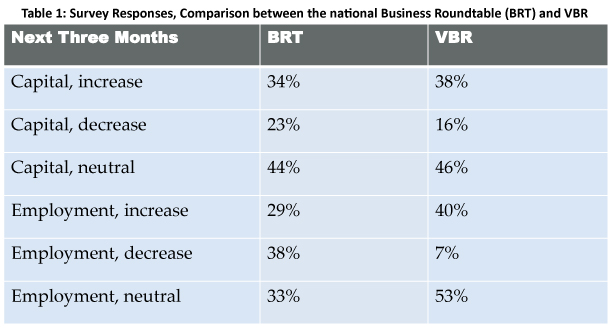

2Qtr2016_Table1_Web

Overall Findings

The latest survey, which was conducted during the first two weeks of April 2016, achieved a response rate of 74 percent overall and included a 50 percent or greater response rate from all but three sectors within the membership.  The survey asked eight retrospective and prospective questions about the CEOs’ economic outlook, demand, capital spending, and employment. Survey results show that:

  • Most responses to the question about the state’s overall business climate outlook were neutral (51%). The remaining responses were split between optimistic (28%) and pessimistic (20%). 
  • More than 60 percent of respondents (62%) shared negative outlooks specifically with ease of hiring for available positions; and,
  • The education sector had the most optimistic outlook on the general business climate, while the health care sector had the least optimistic outlook.

Graph #1 below shows the diffusion index of overall economic outlook, which measures the level of confidence (optimism or pessimism) respondents have about different aspects of the economy based on the first question on the survey, and can range from 100 (where 100% of respondents answered “strong positive”) to -100 (where 100% of respondents answered “strong negative”).

For this reporting period, the diffusion index shows a decline in optimism from Q1 2016 to Q2 2016, indicating that Vermont CEOs continue to feel neutral to mildly pessimistic about the business climate for the coming three months.
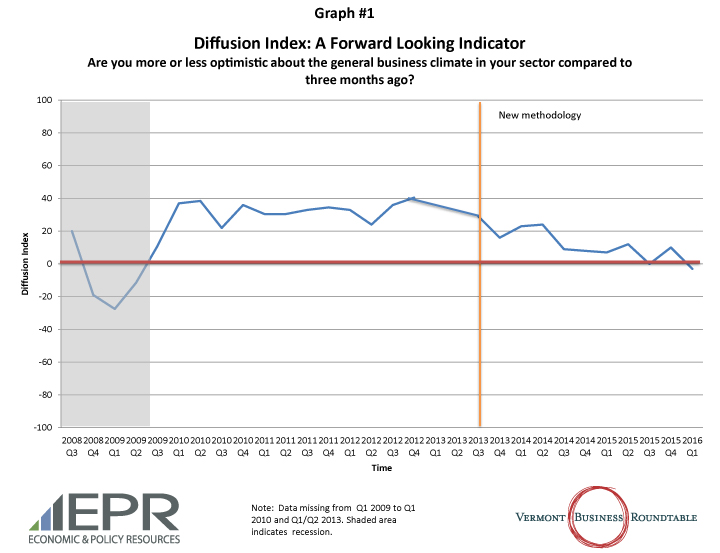
BCS-2Qtr2016_Graph1_Web


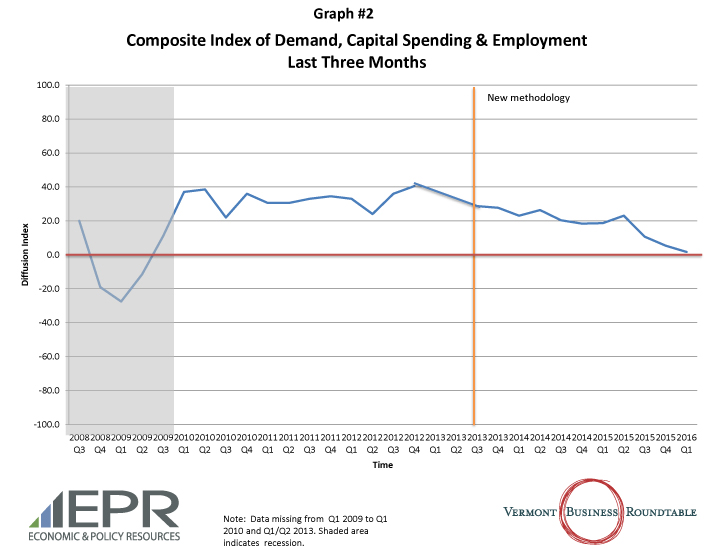
BCS-2Qtr2016_Graph2_Web

Graph #2 above shows the composite index of the diffusion index points for the questions relating to demand, capital spending, and employment in the next three months. The majority of responses were neutral and the index point slid from a mildly optimistic index point of 19 last survey to an index point of 9 this survey, indicating a shift toward true neutral.   The outlook remains in the neutral range.

Also included in the survey was the opportunity for Roundtable members to express their opinions on other topics adversely affecting their businesses. The greatest frequency of responses from members concerned high taxes and tax policies, health care costs, economic growth/development in Vermont, and the difficulty of finding workers.

The next survey will be conducted in early July 2016.


The Vermont Business Roundtable (VBR) is a nonprofit, nonpartisan organization of chief executive officers of Vermont’s leading private and nonprofit employers, representing geographic diversity and all major sectors of the Vermont economy. The Roundtable is committed to sustaining a sound economy and preserving Vermont’s unique quality of life by studying and making recommendations on statewide public policy issues.  www.vtroundtable.org.

Economic & Policy Resources, Inc. (EPR) has been providing private and public sector clients throughout the U.S. and Canada with problem-solving economic research and analysis services for more than 25 years. Our professionals bring a broad spectrum and a deep reservoir of problem-solving knowledge and experience in applied economics to each assignment. We put our capabilities and experience to work for our clients so that they have the insight and understanding necessary to move forward with confidence. EPR has successfully completed assignments throughout the United States and in eastern Canada. www.epreconomics.com.

By Win Smith, Chair
and President, Sugarbush Resort

Once again the House has passed a tax bill and sent it along to the Senate for their consideration.

Last year we spoke about the ongoing “death by a thousand cut” approach that has been coming out of Montpelier for the past several years.  Another few cuts have been proposed by the House.

Rather than taking a strategic approach to tax policy, it seems that Ways and Means Committee is again in search of taxes that will receive the least howls from voters.  Rather than slow our rate of spending to match our economic growth, our legislators are again raising taxes and fees.

On the surface, the increase in mutual fund registration fees sounds reasonable.  After all, Vermont’s fees are lower than the other New England States. What isn’t explained, though, is who really pays for the fees.  It is not Blackrock, Fidelity, or other Wall Street managers of the funds, it is the investors.  You and I and our employees who are buying funds in their IRAs and 401-Ks.  These fees are part of the expenses of the funds and one’s return is net of the fees.   This small increase will not be visible to most, but if we increase ours and others then increase theirs, ultimately the increase will become material.

Then we have the increased deposit tax on the largest banks operating in Vermont.  The message here seems to be, “we love business if you are small, but don’t get big or we will tax you.”  Once again this tax increase does not seem strategic but rather arbitrary. After all these days, who likes “big banks”?  Why would JP Morgan, Bank America, Wells Fargo or others want to do business in Vermont if they see this message?  Our Vermont banks do a good job of supporting businesses in the State, and contribute significant philanthropic dollars to our communities, but many of our businesses benefit from competition and need the services that only larger banks can provide.

And finally, there is the move to increase the fee on uninsured workers and this one directly impacts seasonal business like mine.  Rather than address the growth of Medicaid and figuring out how to fund it appropriately, another tax is suggested, which unfairly burdens a group of businesses.  We offer health insurance to all 155 of our full-time employees, but our winter payroll grows to nearly 1,000 and some of these part-time employees do not signify that they have insurance for a variety of reasons. Some are not even residents of Vermont.  Again, this just increases our cost of doing business compared to our competitors in other States.

These tax and fee increases are not mortal wounds, but we are getting closer.  What is needed is what we have said before.  Let’s dust off the Blue Ribbon Tax Structure Commission report.  It was an excellent piece of work.  It was bi-partisan and strategic, and I believe it is still worth pursuing many of their recommendations, if not all of them.

For the second year in a row the Guidance Office at Winooski High School (WHS) has reached out to the Roundtable to partner with them on their school-wide Aspiration Day. For these students, many of whom are first generation Vermonters or whose parents are new Americans, the idea of migrating from formal school into the workforce is daunting, and school demographics point to additional reasons why it is important for business to have more direct engagement with students.

Winooski is more ethnically diverse than other high schools in Vermont (49% v. 8%); almost 60% of students are eligible for free or reduced lunch; their students score in the bottom 10% of high schools for reading and math proficiency; and the graduation rate of 52% is well below the statewide average graduate rate of close to 90%.

Special thanks to Roundtable members Michael Lash, President and CEO of Ethan Allen Home Interiors, Michael Seaver, Vermont President, People’s United Bank, and Pierre LeBlanc, President, Engeleberth Construction, who took the time to engage in a meaningful way with students who desire to know what it takes to communicate to the business world, how to overcome racial and gender biases, and why it’s important to get as much education as you can.

Want to make a difference in the life of a child? Don’t wait to be invited, just step up in your own community.

In what is becoming a semi-annual event, Chair Al Gobeille met with members of the Roundtable’s Health Care Working Group, chaired by Mike Walsh, to provide an update on progress of the All Payer Model term sheet currently being negotiated with Centers for Medicare and Medicaid Services (CMS). The term sheet describes the basic policy framework that would allow Vermont’s health care providers, payers, and the government to operate an all-payer model. And this framework would ultimately provide an approach to health care payments that reward the health care system for providing high value care and benefit Vermonters.

At its essence the state agrees to coordinate Medicaid and commercial insurers, and commits to financial targets and quality goals, in exchange for which the federal government will allow Medicare to participate in the Vermont system. Gobeille noted that the proposal aims to make health care more affordable by bringing health care spending closer to economic growth; the term sheet sets a 3.5% spending target and a 4.3% spending cap, with a commitment that Medicare will grow more slowly in Vermont than nationally. The financial targets are based on health care services in Vermont’s Medicare, commercial and Medicaid ”shared savings” program today, which covers most hospital and physician services.

Vermont aims to improve quality of care by increasing access to primary care, reducing the prevalence of chronic disease, and addressing the substance abuse crisis. And by working with existing mental health, substance abuse and long-term services and support providers, Vermont will have created an integrated health care system. Al Gobeille and the GMCB, as charged by Act 48, will hold the Accountable Care Organizations (ACOs) financially accountable for quality measures.